
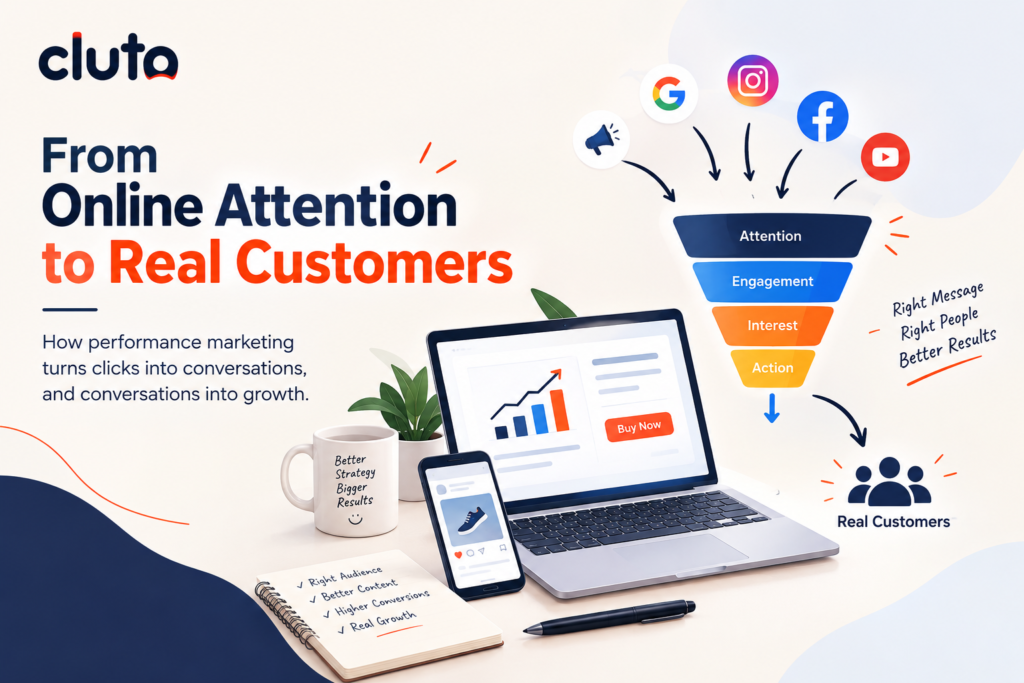
How Performance Marketing Helps Businesses Turn Online Attention Into Real Customers
Getting attention online is easier than ever. Businesses can reach thousands of people through search engines, social media, websites, and online advertising. But visibility alone does not always lead to growth. The real challenge is turning that attention into meaningful actions such as enquiries, purchases, bookings, or sign-ups.
This is where performance marketing can make a difference.
From Visibility to Measurable Results
Traditional marketing often focuses on reaching a large audience. Performance marketing takes a different approach by looking closely at what people actually do after seeing an advertisement.
Did they visit the website? Did they fill out a form? Did they make a purchase? Did they contact the business?
These actions provide useful information about whether a campaign is moving in the right direction.
Instead of simply asking, “How many people saw the advertisement?”, businesses can start asking more valuable questions: “How many people showed genuine interest?” and “Which part of our marketing is producing results?”
Understanding the Customer Journey
A person rarely sees an advertisement and immediately becomes a customer.
They may first discover a brand through social media, search for more information later, visit the website, compare alternatives, and eventually make a decision.
A good digital marketing strategy considers this entire journey.
For example, someone searching for a particular service may already have a strong intention to buy. Another person scrolling through social media may only be discovering the service for the first time.
Both people are potential customers, but they need different messages.
Understanding these differences helps marketers create campaigns that feel more relevant instead of showing the same advertisement to everyone.
Why Data Matters
One of the biggest advantages of digital advertising is the amount of information available from campaigns.
Businesses can learn which advertisements receive attention, which audiences interact with them, which keywords bring visitors, and where people stop during the conversion process.
This information can then be used to improve the campaign.
Suppose an advertisement receives plenty of clicks but very few enquiries. Increasing the budget may not be the answer. The problem could be the landing page, the offer, the targeting, or the message itself.
Looking at the complete journey helps identify what needs to change.
Small Improvements Can Create Big Differences
Performance marketing is not always about making one major change.
Sometimes improvement comes from several smaller adjustments.
A different headline may attract more attention. A simpler landing page may generate more enquiries. A better audience segment may reduce wasted advertising spend. A clearer call-to-action may encourage more people to take the next step.
This is why testing is such an important part of digital marketing.
Instead of assuming what customers want, marketers can test different approaches and use the results to make better decisions.
Choosing the Right Platform
Every business does not need to advertise everywhere.
A local service business may benefit from search advertising because people are already looking for its services. An e-commerce brand may find social media particularly useful for showcasing products. Another business might need a combination of search, social media, remarketing, and content.
The right choice depends on the audience and the business objective.
Spreading a budget across too many platforms without a clear strategy can make campaigns difficult to manage and measure.
A focused approach is often more practical.
The Importance of Good Creative
Data may tell marketers what is happening, but creative content helps communicate with the audience.
A strong advertisement should quickly explain what is being offered and why it matters. Good visuals, straightforward language, and a relevant message can make an advertisement easier to understand.
The goal is not necessarily to make an advertisement complicated or flashy.
Sometimes a simple message that speaks directly to a customer’s problem can perform better than an overly designed advertisement.
Performance Marketing Is an Ongoing Process
One common misunderstanding is that a campaign can simply be launched and left running.
In reality, digital campaigns often need regular attention.
Audiences change. Competition changes. Advertising costs change. Customer behaviour changes. What worked several months ago may not produce the same results today.
Continuous monitoring and optimisation allow businesses to respond to these changes.
This does not mean changing everything every day. It means understanding the available data and making thoughtful improvements when they are needed.
Building Better Marketing Decisions
The real value of performance marketing goes beyond advertising results.
Campaign data can provide businesses with insights into their customers. It can reveal what people are searching for, which products attract interest, what messages generate responses, and what questions potential customers have before making a decision.
These insights can influence website content, offers, sales strategies, and even future products or services.
In that sense, digital advertising becomes more than a way of getting traffic. It becomes a source of information for making smarter business decisions.
Final Thoughts
Online growth is not simply about being seen by more people. It is about reaching the right people with a useful message and creating a clear path from interest to action.
That is what makes performance marketing valuable.
For businesses working with a digital marketing partner such as Cluto, the focus should be on understanding the audience, setting realistic goals, measuring meaningful results, and improving campaigns based on actual performance.
Good marketing does not happen because of one advertisement or one platform. It develops through research, creativity, testing, measurement, and continuous learning.
And when those elements work together, online attention has a much better chance of becoming genuine business growth.