
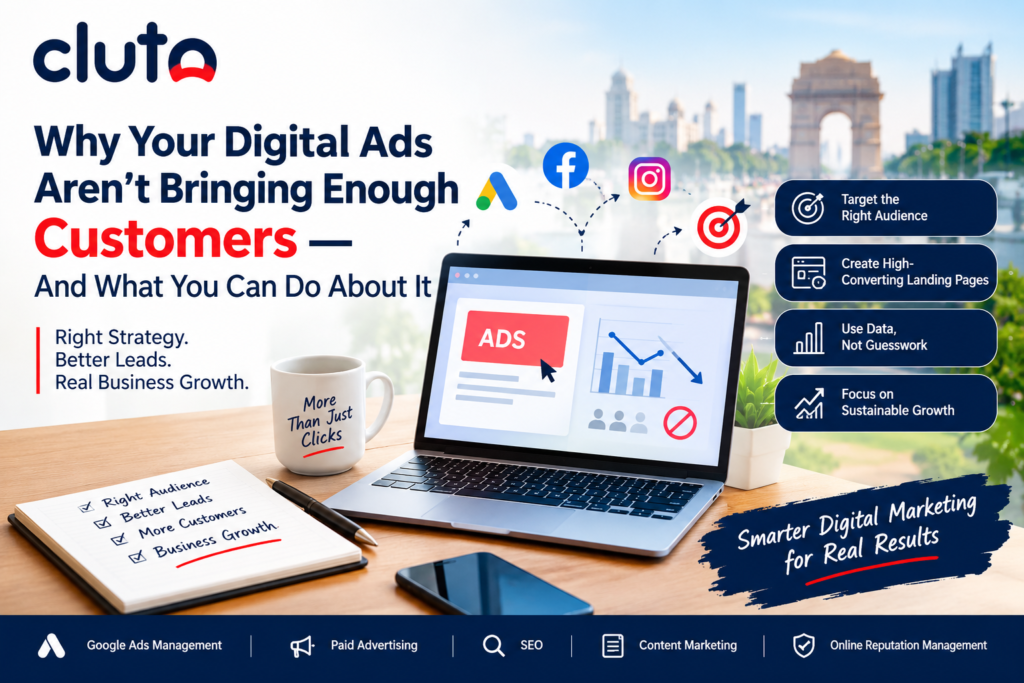
Why Your Digital Ads Aren’t Bringing Enough Customers — And What You Can Do About It
Running digital advertisements can feel exciting at first. You create an attractive ad, select your audience, set a budget, and wait for potential customers to respond. But what happens when the clicks come in and the enquiries do not? Or when you are receiving leads, but most of them are not genuinely interested in your product or service?
This is one of the biggest challenges businesses face today. The problem is often not that digital advertising does not work. The real issue is that advertising without the right strategy can quickly turn into an expense instead of an investment.
For businesses competing in a fast-moving market like Delhi and the wider NCR region, simply running Google or social media ads is rarely enough. Customers have more choices, competitors are constantly advertising, and people often compare several businesses before making a decision. Your marketing therefore needs to do more than generate attention. It needs to attract the right people and guide them towards taking action.
The Real Problem May Not Be Your Advertising Budget
Many business owners believe that increasing the advertising budget will automatically bring more customers. Sometimes it can increase traffic, but spending more money cannot fix a campaign that is targeting the wrong audience or sending visitors to a weak landing page.
Imagine someone searches for your service, clicks your advertisement and reaches your website. If the page is confusing, slow, difficult to navigate or does not clearly explain why they should choose you, that potential customer may simply leave.
The same problem can happen with social media campaigns. An advertisement may receive thousands of impressions and plenty of engagement, but if those interactions do not turn into meaningful enquiries or sales, the campaign is not creating the business result you actually need.
That is why successful digital advertising starts with understanding the customer rather than simply choosing an advertising platform.
More Leads Do Not Always Mean Better Results
Getting enquiries is important, but the quality of those enquiries matters even more.
A business selling premium services, for example, may receive hundreds of enquiries from people who are only looking for the cheapest option. On paper, the campaign may appear successful because the number of leads is high. In reality, the sales team may be spending hours following up with people who were never likely to purchase.
A stronger approach focuses on attracting prospects who have a genuine need, fit the target market and are more likely to become customers.
This requires understanding search behaviour, audience interests, location, buying intent, messaging and the offer being presented. When these elements work together, marketing becomes much more meaningful than simply generating clicks.
Your Website and Landing Page Matter More Than You Think
Advertising can bring people to your website, but your website has to convince them to stay.
A visitor should quickly understand what your business offers, who it is for and what they should do next. Whether that means making an enquiry, calling your business, filling out a form or purchasing a product, the next step should be clear.
A good campaign can lose potential customers if the landing experience is poorly designed.
This is why advertising and website strategy should not be treated as two completely separate activities. Your ads create the first impression, while your landing page helps turn that interest into action.
Data Should Guide Decisions, Not Guesswork
One of the biggest advantages of digital marketing is the amount of information available about campaign performance. Businesses can analyse clicks, enquiries, conversions, audience behaviour and other important signals.
But collecting data is only the beginning.
The real value comes from understanding what that data is saying. Which audience is responding? Which advertisement is generating meaningful enquiries? Where are visitors leaving the website? Which campaigns are producing customers rather than just clicks?
Continuous testing and optimisation can help answer these questions. Instead of assuming that the first campaign will be perfect, marketers can identify what works, improve what does not and gradually make the entire customer journey more efficient.
The Goal Should Be Sustainable Business Growth
Good marketing is not about chasing impressive numbers that look good in a monthly report. A large number of impressions does not necessarily mean a business is growing.
The more important questions are simple: Are you reaching the right audience? Are people taking action? Are your enquiries relevant? Are your advertising costs under control? And ultimately, is your marketing helping generate revenue?
This is where a performance-focused approach becomes valuable. Google Ads, social media advertising, SEO, content and other digital channels can work together when they are planned around clear business objectives.
For businesses looking for a more structured approach, Cluto focuses on result-driven digital marketing solutions, including Google Ads management, paid advertising, SEO, content marketing and online reputation management.
What Should a Business Do Next?
If your current campaigns are not producing the results you expected, the answer is not necessarily to stop advertising. Instead, take a step back and examine the complete journey from the first impression to the final conversion.
Look at your audience. Review your advertisements. Analyse your website. Check your conversion tracking. Understand the quality of your leads. Then identify where potential customers are dropping away.
Sometimes a small change in targeting or messaging can make a significant difference. In other situations, the problem may require a complete rethink of the campaign and customer journey.
The important thing is to make decisions based on evidence rather than assumptions.
Marketing That Works for the Business, Not Just the Dashboard
Every business wants more customers, but achieving that goal requires more than simply being visible online. It requires understanding what customers are searching for, what problems they are trying to solve and what makes them choose one business over another.
Digital marketing becomes much more powerful when every part of the process has a purpose — from the advertisement and content to the website, enquiry process and follow-up.
If your business is investing in online advertising but still feels that the results are unpredictable, it may be time to look beyond clicks and impressions.
The right strategy is not necessarily about spending more. It is about making every marketing decision more intentional, measurable and connected to the outcome your business actually wants.
A smarter digital strategy can turn online visibility into genuine opportunities, stronger customer relationships and sustainable growth.